
Keep Your Pond From Freezing Over This Winter
When your pond freezes over, the danger to your fish isn't the cold. It's the air.
The fix is simple: keep one small hole open in the ice so your pond can breathe until spring. The right equipment for that depends on how cold your winters get and how big your pond is, and this page will help you choose in about a minute.
Find the right setup for your pondQuestions before you buy? Call (512) 601-8197 and talk to a real person.

- 1Ice seals the surface. Gases from decaying leaves and fish waste build up underneath.
- 2One open hole lets the pond breathe. Gases go out and fresh oxygen comes in.
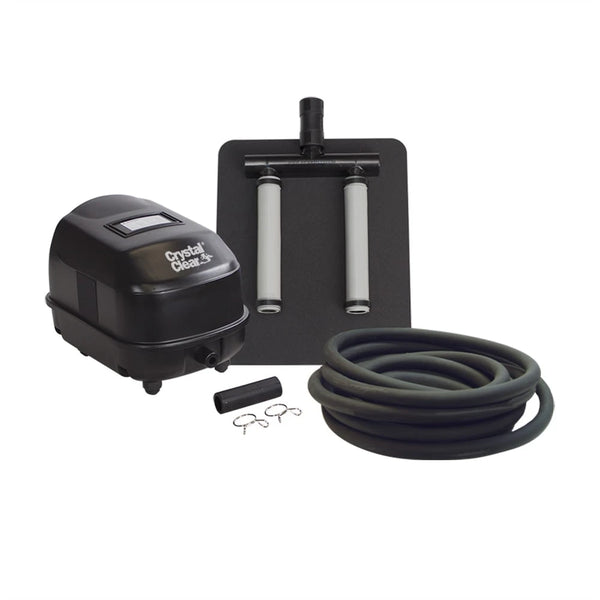
- 3The air stone sits on a shelf, about a foot below the surface. Its bubbles keep the hole open.
- 4Fish rest near the bottom, where the water stays warmest.
Pond fish like koi and goldfish handle cold water just fine. In winter they slow down and rest near the bottom, where the water stays warmest. The real risk is a solid sheet of ice. Leaves, fish waste, and other debris keep breaking down all winter, releasing gases that need somewhere to go. When the surface is sealed, those gases build up under the ice and fresh oxygen can't get in.
How keeping a hole open works
Lets harmful gases escape.
Gases from decaying debris vent out through the opening instead of building up under the ice.
Lets oxygen in.
Air exchange at the opening keeps oxygen available for your fish all winter.
Runs on its own.
Set up your aerator or de-icer before the first hard freeze and let it run until the ice is gone.
Winter mistakes to avoid
Don't smash the ice.
Hitting the ice sends shock waves through the water that can stress or harm resting fish. If you need to open the ice, melt a hole with hot water instead.
Don't leave the air stone at the deepest point.
In winter, raise it to a shelf about a foot below the surface so it doesn't mix away the warmer water at the bottom where your fish rest.
Don't count on your waterfall.
Waterfalls and streams can freeze and divert water out of the pond, lowering the water level. They also can't be relied on to keep a hole open, so use an aerator or de-icer for that.
Find the right setup for your pond
| Your pondSize in gallons | Milder wintersIce comes and goes | Severe coldIce stays for weeks |
|---|---|---|
| Up to 1,000 gallons | Airmax PondAir 2 aeration kit | Airmax PondAir 2 aeration kit plus a K&H Thermo-Pond de-icer |
| 1,000 to 2,000 gallons | Airmax PondAir 4 aeration kit | Airmax PondAir 4 aeration kit plus K&H Thermo-Pond de-icers, one for every 1,200 gallons |
| 2,000 to 8,000 gallons | Airmax KoiAir 1 aeration kit | Airmax KoiAir 1 aeration kit plus K&H Thermo-Pond de-icers, one for every 1,200 gallons |
Choose the right de-icer wattage
Bigger isn't better here. The right size depends on how cold your winters get and how much water you have. Find your USDA hardiness zone, then your pond size:
Not sure of your zone? Look it up by ZIP code on the USDA map, or match the coldest nights of your winter to the first column.
| ZoneColdest nights | Up to 100 gal | 100 to 400 gal | 400 to 750 gal | 750 to 1,000 gal | 1,000 to 1,200 gal |
|---|---|---|---|---|---|
| 3−40 to −30°F | 250 W | 750 W | 1500 W | 1500 W | 1500 W |
| 4−30 to −20°F | 250 W | 750 W | 1500 W | 1500 W | 1500 W |
| 5−20 to −10°F | 250 W | 250 W | 750 W | 750 W | 1500 W |
| 6−10 to 0°F | 250 W | 250 W | 250 W | 750 W | 750 W |
| 70 to 10°F | 250 W | 250 W | 250 W | 250 W | 750 W |
| 810 to 20°F | 250 W | 250 W | 250 W | 250 W | 750 W |
Pond over 1,200 gallons? Use more than one de-icer: split your pond's volume into the columns above and pick a unit for each part. A 3,500 gallon pond, for example, needs three.


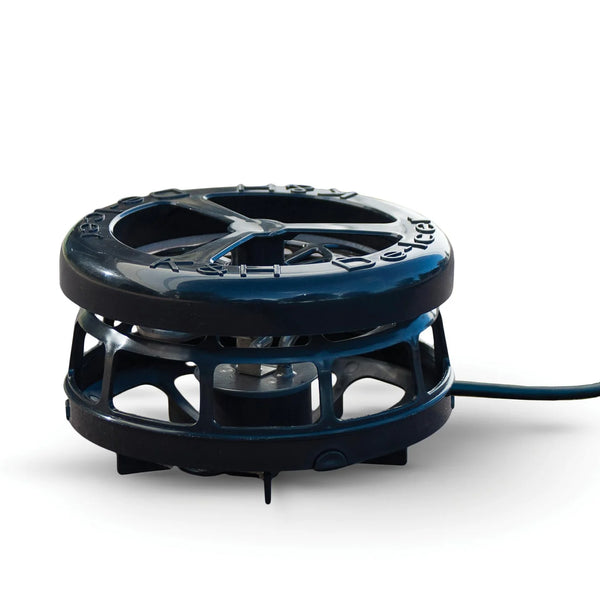
K&H Thermo-Pond Perfect Climate De-Icer
250, 750 or 1500 watt, for severe cold
Questions before you buy? Call (512) 601-8197 and talk to a real person.